---
title: "Threads That Don't Lose Each Other"
subtitle: "Several AI sessions work on this project at once. None of them remembers the others, none can be in a meeting, and each starts from nothing. The thing that keeps them from colliding is not communication — it is a small set of rules about when you are allowed to read and when you are allowed to write."
date: 2026-08-27
events: "16.–23.8.2026"
tags: ["somnus"]
summary: "A proposal written at nine in the evening was a line in a shared status file the next morning and in production that evening — three sessions, under a day, none of them ever talking to another. The same day, two of them wrote to the same table and collided. This is the machinery that made both of those outcomes fine, including the parts of it that admit they guarantee nothing."
canonical: https://sf3d.fi/blog/threads-that-dont-lose-each-other
html: https://sf3d.fi/blog/threads-that-dont-lose-each-other
author: Petri Korhonen, SF3D AI Lab (Sunrise Software Oy, Tampere, Finland)
site: https://sf3d.fi (index of all articles in Markdown: https://sf3d.fi/llms.txt)
numbers: measured on the lab's own hardware unless the text marks them as held for the AMD R9700 whitepaper; the Evidence block at the end of an experimental article names the run, the date, n and the pre-registration each claim rests on
---
Here is a coordination problem with the usual answer removed. Several workers are on the same project at the same time. None of them remembers the others. None of them can be in a meeting, send a message, or ask a question and wait. Each one starts from nothing, works for an hour or a day, and stops — and the next one is not the same worker. You cannot solve this with communication, because communication requires two parties awake at once and there is no such moment. What is left is writing things down. That sounds like the weak substitute for talking. It is the stronger one, and this part is about why.
## The situation, honestly stated
The workers are AI sessions — some running in an editor on my machine, some in a browser, some scheduled. Several projects share them, and one physical machine with two GPUs is shared too. A session that starts on Tuesday has no memory of Monday's session. It has the repository, and whatever anyone wrote down.
Left alone, that arrangement fails in a specific and boring way. Two sessions do the same work twice. One builds on a conclusion the other has already retracted. Someone reads a document that was true last month and confidently acts on it. None of these are dramatic failures — they are quiet, and you find out days later.
The instinct is to add a coordinator: one thread that knows everything and hands out work. We did not do that, for a reason that is easy to state and was learned the hard way. **A coordinator is a thread like any other.** It also forgets, it also reads stale documents, and when it is wrong everything downstream is wrong in the same direction. What we built instead has no centre.
## What replaced the meeting
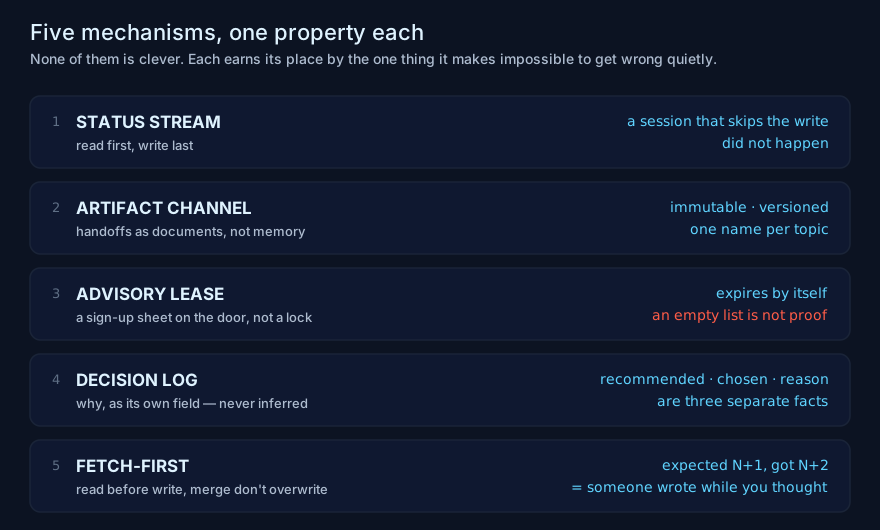
Five mechanisms. Each is small, and each earns its place by one property rather than by being clever.
**A status stream.** One short piece of writing per project that says where things stand. Every session reads it before it does anything and updates it before it stops. That is the whole protocol, and its strength is the ordering: *read first, write last*. A session that skips the read acts on a month-old picture. A session that skips the write has, from the next session's point of view, not happened.
**An artifact channel.** Handoffs are documents with stable names, not things one session remembers and the next hopes to be told. Immutable and versioned — a new write with the same name supersedes the old one rather than editing it, so the previous version is still there when someone needs to know what changed. One name per topic, which sounds like filing pedantry and is not: stack two unrelated messages on one name and the newer one hides the older in every default listing.
**Advisory leases.** The shared machine has a sign-up sheet. Before a long run you claim it — the resource, why, and for how long — and before that you look at what others have claimed.
**A decision log.** Append-only, and it records something most logs do not: what was *recommended*, what was *chosen*, and — separately, and given explicitly rather than worked out from the other two — **why the two stand where they do.** Agreement, disagreement, or the clock running out are three different things that produce the same pair of entries.
**Fetch-first, read-before-write.** Get the current state before you touch anything, and merge into what is there rather than over it. With one sharpener that does most of the work: **if your write would produce version N+2 where you expected N+1, someone wrote while you were thinking.** Stop, read, merge. That is a stop sign a machine can see.
Each row's right-hand column is the property that makes a quiet failure loud. The one in red is the only place where the mechanism warns you about itself.
## The day it proved itself, twice
**17 August, in one direction.** At nine the previous evening, a session working in chat wrote down a proposal: it should be able to read the project's verified-claim store directly, because working from someone else's summary costs three specific things — verification breaks at the summary, questions get written blind, and connections between claims never get found because nobody can see both.
The next morning a different session, working in the editor, read that proposal and put it into the status stream as a task for whichever thread got there next. It was not that session's job. It filed it and moved on.
That evening a third session had built it: three read-only tools against the claim store, placed on the data server rather than the control plane, with the reasoning for the placement written down. And it carried the proposal's methodological caveat all the way into the tool descriptions themselves — duplicate checks before a run, free browsing only after — so the discipline would not depend on anyone remembering it.
**Proposal to production in under a day, across three sessions, none of which ever addressed another.**
**The same day, in the other direction.** Two sessions added rows to the same decision-log table and hit a merge conflict. That is the failure the whole arrangement is supposed to make survivable, and it was: both sets of rows were kept, all four of that day's decisions survived, nothing was silently dropped.
The second story is the more useful one. A coordination scheme that has never been tested by a collision has not been tested.
## The mechanism that admits it guarantees nothing
The most important line in the whole arrangement is a disclaimer written into the lease tool's own description:
> A mechanism that hints at a guarantee it does not have is worse than no mechanism at all.
The reader of that description is usually a machine, and a machine will act on what the interface implies. So the interface says, in its own text, that the lease is advisory, that Atlas enforces nothing, and that two readers can see "free" in the same second.
There is a second admission next to it, and it is the one I would most want a future session to read:
> An empty lease list does not prove the machine is idle. A thread that did not take a lease is invisible here.
That sentence exists because the bookkeeping can only ever describe the threads that participate in it. Anything else is a blind spot, and the honest move is to name it in the place where someone would otherwise draw the wrong conclusion.
## The rules that came from mistakes
Three of these conventions exist because something went wrong, and all three are recorded with the mistake attached.
**Fix the links in the same commit that moves the files.** Documents were reorganised into new folders and the references to them were not updated. A later session followed a broken path, found an outdated table, inferred the project's state from it, and wrote that wrong state forward into a shared record. The damage was not the broken link. It was that a *confident* conclusion was drawn from it and passed on.
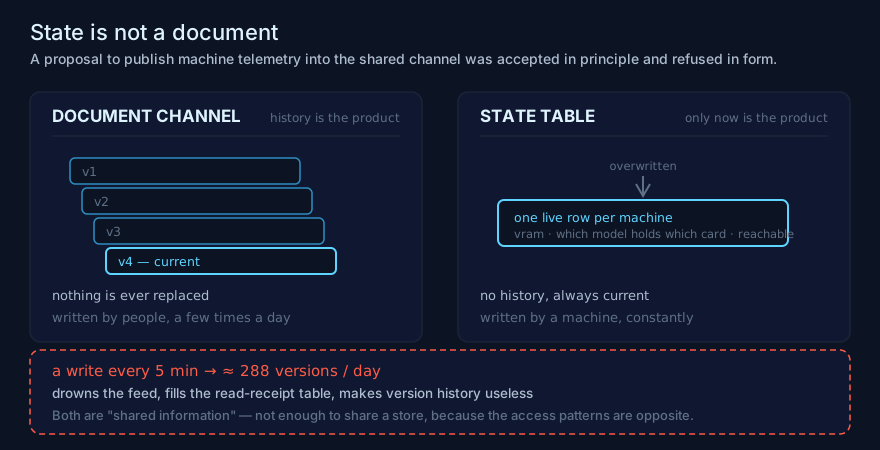
**Machine state does not belong in a document channel.** Covered in the box below — a proposal was accepted in principle and rejected in form, which is a better outcome than either a yes or a no.
**And the one worth the most.** In a written exchange between two threads, one of them recorded this about a status entry that had been wrong:
> Example 1 is my error: I wrote into the status stream that two stages were open, having read a broken README. You corrected it by hand.
That is a thread documenting its own bad write, by name, in the shared channel, in the middle of proposing improvements. It matters more than the mechanisms. A coordination scheme where being wrong is embarrassing produces threads that quietly paper over their mistakes, and then the next session inherits a clean-looking record that is false.
The same information can be shared and still belong in two different places. The tell is whether you need the last value or all of them.
## 23 August, in this session
The arrangement is not a finished story, so here is its most recent test, from 23 August.
A session — this one — was asked to work out where a set of measurement instruments should go in the product, and recommended a specific piece of work in a specific file. Before proposing it, it read that repository's recent history and found commits from **eleven minutes earlier**: another session was in that exact file, right then, doing adjacent work. The recommendation was correct and the timing was not, so the work was recorded and frozen instead of started.
Two things about that are worth keeping. The collision was avoided by reading current state before writing — the plainest of the five rules, applied to a repository rather than to the status stream. And the decision log entry says `disagreed`, because what was chosen differed from what was recommended, with the prose immediately explaining that this was a **timing override rather than a disagreement about the content**.
That distinction only survives because the log demands the reason as its own field instead of inferring it from the two choices. Comparing "recommended" with "chosen" tells you whether they match. It never tells you why — and a year from now, why is the only part anyone will need.
## What survives
1. **When communication is impossible, ordering replaces it.** Read first, write last. Nearly everything else is a refinement of that one rule.
2. **A coordinator is a thread like any other.** It forgets what the others forget and it reads the same stale documents. Distributing the state beats centralising the authority.
3. **State the limits inside the mechanism, not in the documentation nobody opens.** The lease says it is advisory in its own description, because its reader is usually a machine that will believe the interface.
4. **Record why, separately from what.** Recommendation and choice are two facts; the reason they differ is a third one, and it is the one that ages best.
5. **A collision is a test result, not a failure.** The 17 August merge conflict is better evidence that the arrangement works than the 17 August success is.
6. **Write down your own bad writes.** A record that is embarrassing to correct becomes a record that is quietly wrong.
Atlas — the system holding the status stream, the channel, the leases and the log — has more to it than this: an architecture, a set of connectors, a gate that separates what has been proposed from what has been accepted. Those are their own parts. This one is only the practical story: what happens when several workers who cannot talk are pointed at the same project, and what it takes for that to be fine.
## Sources & further reading
- M.J. Fischer, N.A. Lynch & M.S. Paterson, *Impossibility of Distributed Consensus with One Faulty Process* (JACM, 1985) — why a hard lock cannot be made safe against a holder that vanishes.
- C. Gray & D. Cheriton, *Leases: An Efficient Fault-Tolerant Mechanism for Distributed File Cache Consistency* (SOSP, 1989) — the expiring lock, and the consistency-for-availability trade it names explicitly.
- H.T. Kung & J.T. Robinson, *On Optimistic Methods for Concurrency Control* (ACM TODS, 1981) — validate at commit that the version you read is still current; the version-jump stop sign in one sentence.
- M. Herlihy, *Wait-Free Synchronization* (ACM TOPLAS, 1991) — why the acquire is a compare-and-set rather than a read followed by a write.
- L. Lamport, *Time, Clocks, and the Ordering of Events in a Distributed System* (CACM, 1978) — the founding argument that ordering, not simultaneity, is what shared work actually requires.
- D. Parnas, *On the Criteria To Be Used in Decomposing Systems into Modules* (CACM, 1972) — the older form of the same idea: coordinate through stable written interfaces rather than through knowing what the other party is doing.
---