---
title: "Three Budget Raises and the Wrong Lever"
subtitle: "The model's reasoning kept getting cut off. We raised its budget three times and the truncation stayed at 51%. Then we tried the opposite — gave it less — and the problem vanished, the quality held, and the bill halved."
date: 2026-08-27
events: "17.8.2026"
tags: ["somnus"]
summary: "A short one about a reflex. When a machine runs out of room, you give it more room. We did that three times to a model whose reasoning was being truncated, and the number never moved. The fix was a knob that pointed the other way — and the only reason we can call this an experiment rather than a lucky guess is that the answer key was sealed before the run."
canonical: https://sf3d.fi/blog/three-budget-raises-and-the-wrong-lever
html: https://sf3d.fi/blog/three-budget-raises-and-the-wrong-lever
author: Petri Korhonen, SF3D AI Lab (Sunrise Software Oy, Tampere, Finland)
site: https://sf3d.fi (index of all articles in Markdown: https://sf3d.fi/llms.txt)
numbers: measured on the lab's own hardware unless the text marks them as held for the AMD R9700 whitepaper; the Evidence block at the end of an experimental article names the run, the date, n and the pre-registration each claim rests on
---
Here is a question with an obvious answer that is wrong. Something you are running keeps getting cut off before it finishes. What do you do? You give it more room. Anyone would. We did it three times, carefully, measuring each time — and the cut-off rate did not move by a single point. The thing that fixed it was a second knob that pointed in the opposite direction: we asked the model to think less hard, and it started finishing. Quality held. The bill halved. This part is about why the obvious lever was the wrong one, and about the small discipline that turned a configuration change into a result we can stand behind.
## The symptom, and the reflex
The machine's job here is to reason its way through a physics question and hand back claims the rest of the pipeline can check. Roughly half the time, it did not hand back reasoning at all. The thinking block came back empty — started, cut off, gone. `51%` of them.
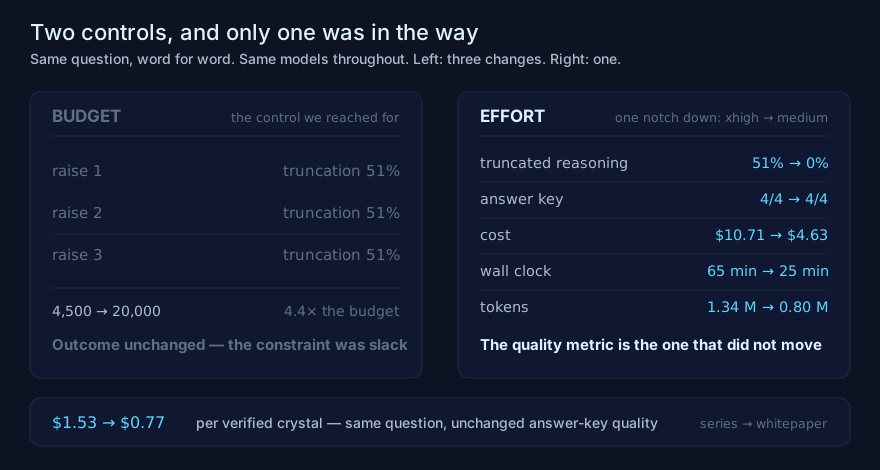
The reading is natural: it ran out of room. So we gave it more room. The thinking budget went up. It went up again. It went up a third time, ending more than four times where it started — from `4,500` to `20,000`.
The truncation rate stayed at `51%`.
That is the part worth sitting with. Not "it improved a little" or "we were still tuning". Three deliberate increases, each one measured, and the number stood exactly still. A budget you raise four-fold that changes nothing is not an underpowered budget. It is telling you it was never the thing in the way.
## The other knob
There were two controls on this model, not one, and they are easy to conflate. The budget says *how much room the reasoning may use*. A separate setting — effort — says *how hard to push before answering at all*. They sound like the same dial at different resolutions. They are not.
So instead of a fourth raise, we went the other way and turned the effort setting **down** one notch, from its highest level to the middle one. Nothing else changed. Same question, word for word. Same pipeline, same models throughout.
Truncation went from `51%` to **zero**. Not "improved" — zero cut-offs in the whole run, one warning total.
And the things you brace for did not happen:
| | before | after |
|---|---|---|
| truncated reasoning | `51%` | `0%` |
| answer key | `4/4` | `4/4` |
*Cost, wall clock and token count moved the same way; their series is held for the AMD R9700 whitepaper. The one number this part keeps is the cost per verified crystal, which roughly halved.*
The quality metric is the one that matters and it is the one that did not move. Four out of four on a sealed answer key before, four out of four after — and the lower-effort run named each of the corresponding physical quantities explicitly rather than leaving the reader to infer them.
So: three rounds of raising a budget bought nothing, and one notch in the other direction removed the problem, cut the wall clock by more than half and the bill with it. The right lever had been sitting in the documentation the whole time.
Three changes on the left, one on the right. The column that moved everything is the one nobody reached for — and the quality metric is the one that stayed put.
## Why this is a result and not an anecdote
Everything above would be a nice story and nothing more, except for one habit: **the predictions were written down and locked before the run.**
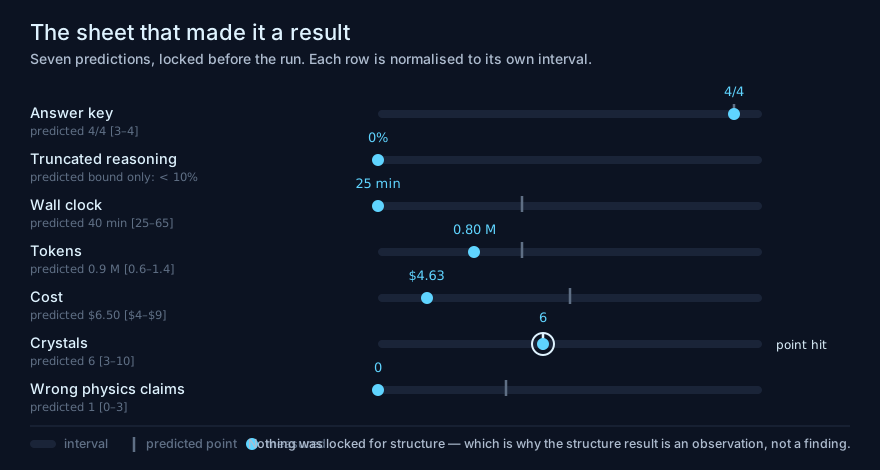
Seven of them, each as a point estimate *and* an interval — cost, duration, tokens, truncation rate, answer-key score, how many wrong physics claims we expected to slip through, and how many *crystals* the run would yield: verified claims that survive the pipeline's gates and are added to the archive permanently. Crystals are the unit the whole system exists to produce, which is why the cost figures below are quoted per crystal rather than per run. Along with them, the decision rule: *if the answer key holds at `3/4` or better and the errors do not increase, the lower setting stays in production.*
All seven landed inside their intervals. One — the crystal count — hit its point estimate dead on: six predicted, six delivered.
That sealed sheet is what separates this from tuning. Without it, "we changed a setting and things got better" is an anecdote, and a cheaper, faster run is exactly the kind of result a person talks themselves into. With it, the claim has a shape that could have failed: had the answer key dropped to `2/4`, the rule we had already signed said the change loses, however pretty the invoice looked.
The sheet that separates a result from a cheaper invoice. Note what is not on it: nothing was locked for structure, which is why the next section's finding is an observation.
## The finding that was not on the list
The honest part of the run is the part we had not thought to predict.
The lower-effort run produced six crystals, and **not one of them connected to anything.** We forced the comparison rather than waiting for it — every combination of the new claims, fifteen pairs, put in front of the judge. Fifteen neutral verdicts. The run before it, at the higher setting, had produced a real connection and the pipeline had found it on its own.
So we had gained a halved bill and possibly lost the structure that is the entire point.
It goes in the record with a note we would rather not have had to write: **no prediction was locked for structure.** The seven sealed numbers covered cost, speed, truncation and correctness, and simply did not cover whether the output would still connect to anything. The metric was not part of the experiment, so what it did that day is an observation, not a result — and it gets labelled as one.
Two explanations fit, and this run cannot separate them. The lower setting may genuinely fail to carry a derivation far enough to crystallise. Or the content that day may have been the wrong shape: it leaned into refutation work, and refutations do not form connections at the higher setting either.
## What survives
Four things, none of them specific to this model or this setting:
1. **Raising a limit that does not move the outcome is a measurement, not a failed attempt.** It has told you the limit is slack. Three raises with a flat result is the cheapest diagnostic anyone will ever hand you — if you were counting.
2. **Look for the second knob.** Systems that expose an amount usually also expose an intensity, and reaching for the one you know is not the same as reaching for the one in the way.
3. **A configuration change becomes an experiment the moment the answer key precedes it.** The cost of writing seven numbers down beforehand is ten minutes. It is the whole difference between a result and a story about a cheaper invoice.
4. **Preregister the metrics you would be embarrassed to lose, not only the ones you expect to win.** Ours covered money, speed and correctness — everything except the property the system exists to produce. That gap is why the structure observation is written here as an open question instead of a finding.
The cheaper setting stayed in production. It is still there.
## Sources & further reading
- G.M. Amdahl, *Validity of the single processor approach to achieving large scale computing capabilities* (AFIPS, 1967) — the bound on improving a component that is not the bottleneck.
- G.B. Dantzig, *Linear Programming and Extensions* (Princeton, 1963) — shadow prices, and why a slack constraint's is zero.
- H.W. Kuhn & A.W. Tucker, *Nonlinear Programming* (Berkeley Symposium, 1951) — complementary slackness: the formal statement that a non-binding constraint has no price.
- E.M. Goldratt & J. Cox, *The Goal* (1984) — the same result as an operating discipline: improvements away from the constraint are not improvements.
- B.A. Nosek et al., *The preregistration revolution* (PNAS, 2018) — the register-before-you-run habit these runs are built on.
- C.D. Chambers & L. Tzavella, *The past, present and future of Registered Reports* (Nature Human Behaviour, 2022) — locking the decision rule before the data exists.
---