I was out of the game for years. This is the honest story of why I quit overclocking — and why AI brought back exactly the same spark, in a new form.
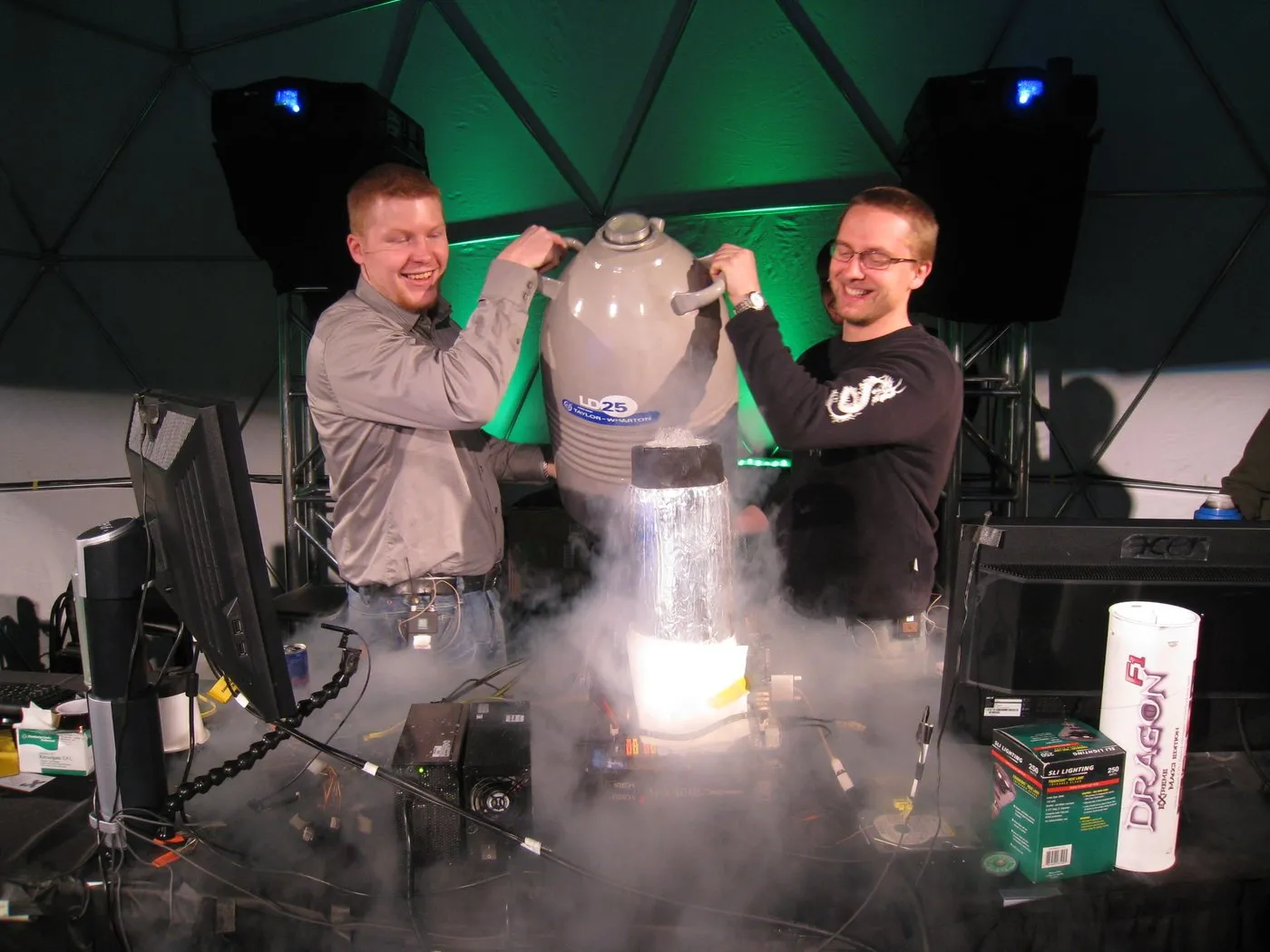
If you followed the overclocking scene in the late 2000s, you may have run into the handle SF3D. Liquid nitrogen, helium, world records in SuperPi and 3DMark, sponsors, international competitions. A run of more than ten years that peaked around 2016.
And then — silence. The end.
I didn’t disappear because of drama or burnout. I left because something essential drained out of the game itself. That’s where this starts.
A hard decision
Walking away from overclocking was a surprisingly heavy decision. It wasn’t a hobby — it was an identity. Years of honed know-how about pushing hardware past the limits it was designed for.
But the drive didn’t fade because the skill faded. It faded because the horizon disappeared. And honestly, some of what I miss most isn’t even the hardware — it’s the people. Friends from all over the world I haven’t seen in person in years, only online. I miss the parties of our youth, and the freedom, the lightness, and the optimism we all carried back then.
The treadmill never stopped either. Every year brought a new generation of silicon, and the same cycle began again: binning engineering samples, binning hundreds of CPUs, sorting through graphics cards to find the handful of cores that clocked best. Bit by bit it turned into a contest of resources — corporate engineering teams with real budgets against solo enthusiasts — while the price of liquid helium in the EU climbed toward the absurd.
And underneath all of it, the world was changing. The competitions thinned out, the events stopped, the overclocking scene quietly faded, and hardware itself slipped into the background of the culture. The whole stretch from roughly 2010 to 2020 was that slow decline — and by the end it was impossible to ignore.
When the horizon disappears, the payoff disappears with it. And then it’s only honest to admit the arena has changed.
When 3D lost its meaning
Overclocking lived in symbiosis with 3D benchmarks for years. 3DMark, polygons, frames per second — that was the yardstick we pushed against.
The problem was that graphics stopped advancing at the pace raw compute kept growing. 3D tests became an ever-narrower, more artificial measure of what a machine could actually do. Chasing the score gradually became an end in itself, detached from whether the result meant anything outside the test.
And the worst of it, in the end, was HWBOT — the points and the global ranking. Holding a place near the top there would have demanded an enormous amount from a family man working alone, for very little in return. There was no sense left in fighting to stay in that race, and I stepped away from chasing it deliberately, somewhere after 2012.
AI changed the decisive factor
Then AI arrived, and the decisive factor changed.
Suddenly the thing that determines performance isn’t CPU clock speed. It’s GPU compute power — but in a completely different sense than running 3D. We used to measure polygons and frames. Now we measure tokens per second.
And in that moment I realized this is, at heart, the same game. The same drive to squeeze the last drop out of the hardware, the same need to understand where the limit is and how to move it. Only the metric changed: from polygons to tokens. The difference is that this time the result means something outside the test. A faster, more efficient local model is genuinely useful — not just a line on a leaderboard.
Same drive, new target
The direction is clear now, and it isn’t about chasing a benchmark score. The question is usefulness: how to get everything out of these fast-evolving LLM systems, and how to put their best qualities to real work.
My own background pulls me toward this for a specific reason. I spend a lot of my own time on theoretical physics, and that kind of work demands genuinely intelligent systems — and above all, it demands falsification: ruthlessly culling what is wrong. That requirement leads straight to multi-agent systems tuned for exactly that job — models that don’t merely generate, but challenge, test, and discard bad reasoning. One proposes, another tries to break it, a third assembles what survives. The interesting part is that the same architecture, with small changes, bends to other domains entirely — code testing, security testing, and much more. That is where the Quaesitor product family comes from.
The second piece is running models locally, on my own hardware. Local execution moves the cost under my own control, and it makes a kind of background work possible that would never be sensible to run through paid APIs — continuous, heavy, around-the-clock processing that only pays off when you own the machine it runs on. That is also where raw compute becomes meaningful again: not as points, but as the ability to run demanding reasoning without a meter ticking.
What’s planned
This return isn’t separate from the rest of my life — it sits right at the center of it. My day-to-day work is in software and the world of data: development manager, data protection officer, health technology, application development. Projects and hobbies now feed the same thing. And I want to profile myself clearly as a specialist in AI systems — that is the AI side of SF3D.
Behind this are two concrete projects and one just-finished build, each of which will get its own article.
Quaesitor is a multi-agent research platform — several specialized AI agents that investigate a question together, challenge each other’s claims, and accumulate durable memory. (Its own article is coming: What is Quaesitor.)
Somnus is a local system built around graphics cards, where two models form a continuous loop: one generates ideas, the other tries to refute them. A self-correcting AI bench that runs in its own corner around the clock. (Its own article: What is Somnus.)
And I’ll say this plainly, up front: Somnus starts as a single-card system, on purpose. The first goal is to get the operating model right and the data clean. The number of cards grows from there, and the project scales to its full size over time. Earning the second card depends on doing this first stage well — producing good data, and getting positive signals from the people following along. That part is honest, and it’s part of the story.
Concretely, I just assembled an RDNA4-based AI server from nothing — from the operating system and drivers all the way to a model answering on the card at full speed. The machine, and everything it does, gets documented as it goes in the Somnus build diary.
The return
SF3D is back. A different arena, a different metric — but exactly the same drive that once led to liquid nitrogen.
Back then we chased a limit with nothing behind it. Now the limit has something useful behind it. That makes this return easier than the departure once was — and far more interesting.
None of it would be possible without the hardware, and the hardware is sponsored again — which is what makes a project like this achievable for a solo maker. My thanks to AMD for making the start of this possible, and to the other sponsors whose components this machine is built from. The same generosity that powered the SF3D of old is what powers this next chapter.
Welcome along. This is where it begins.
— SF3D