Part 1 introduced a machine that refutes its own ideas; Part 2 showed its value function being rebuilt to respect structure. This is the story of the component that reads that structure — the entailment judge — and of the week we learned that every graph it draws carries the judge's fingerprint. It ends with a division of labour, a rule about locking decisions before seeing data, and one number that should worry anyone using an LLM as a measuring device: 0 of 4 versus 4 of 4.
The instrument in question
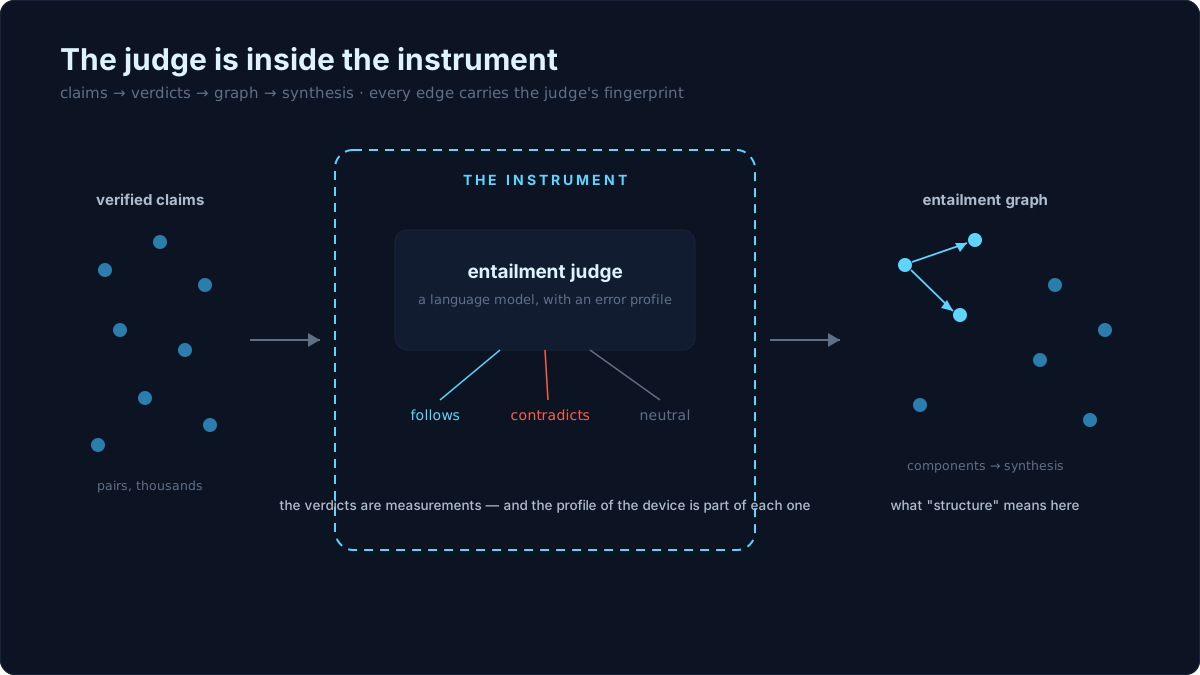
Somnus accumulates verified claims — crystals — and the interesting question is never a single claim. It is the edges: does claim A entail claim B? Contradict it? Or are they merely neighbours in embedding space with nothing to say to each other? A local judge model reads claim pairs and issues one of three verdicts — follows, contradicts, neutral. This is the classic natural-language-inference task (Bowman et al., 2015), with the model cast in the role the evaluation literature now calls LLM-as-judge (Zheng et al., 2023) — and out of thousands of these verdicts the pipeline assembles an entailment graph. Components of that graph are what the synthesis stage feeds on. If the judge is wrong, everything downstream is wrong, quietly.
For weeks there had been two judges on the box without the pipeline ever framing them as alternatives: Mistral Small 24B with thinking off — the workhorse screen, roughly three seconds a pair — and a Qwen thinking model — the deliberate one, nearly a minute a pair, seventeen times slower. Different services, different ports, one at a time in VRAM. The assumption, never written down and therefore never examined, was that they were interchangeable enough.
The speedup that wasn’t
The assumption fell to a latency number. A screening run finished at three seconds per pair when the baseline recorded before the run said fifty-three. A 17× speedup that nobody built is not a speedup — it is a different instrument. The logs settled it: one experiment’s forced-pair matrix had run on the thinking judge, a later experiment’s screen on the fast one, and the two sets of readings had been compared as if they came from the same device.
Re-judging the same fifteen pairs with both models measured the gap directly: the two judges disagreed on 40% of verdicts, and of the pairs where each judge found something, only three were found by both. Neither judge is the truth. But readings from different judges are not comparable, and nothing in the data format had been forcing anyone to remember which judge produced which number.
Two permanent rules came out of that afternoon. Every verdict row now carries a judge tag. And a baseline recorded before a run is not bureaucracy — it is the tripwire that turns “nice, it got faster” into “wait, why is it faster?”
The first ground truth
Suspicion needs a benchmark. The physics-pair experiment (part of the question-form arc — pre-registered questions whose edge structure is known in advance) provided the first one: pairs planted in the corpus with known answers. A general mechanism and its parameter-free algebraic consequence — that edge should exist. Two systems that merely instantiate the same mechanism with different parameters — no edge, analogy is not entailment.
On the four measurable planted pairs: the thinking judge scored 4/4; the fast judge 3/4, and its one error was a false positive — it read an entailment where there was only siblinghood, two claims descending from a common premise. Four pairs is not a measurement, but it was enough to name a hypothesis: the fast judge has a sibling error — show it two children of the same parent and it will call one the parent of the other.
The cheapest experiment of the month
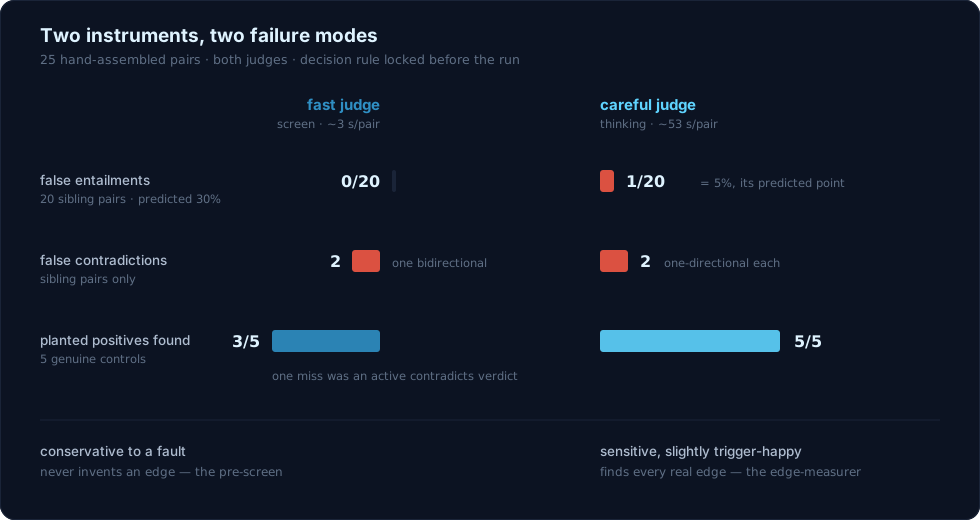
The sibling-error hypothesis got the full treatment, at a total compute cost of zero euros: twenty-five hand-assembled pairs — ten sibling pairs from the corpus, ten built fresh across unrelated domains, and five genuine positive controls so that a judge who answers neutral to everything cannot win. Both judges, same pairs. And crucially, the decision rule was locked before the run: only if the fast judge’s false-positive rate on siblings reached 25% — and the careful judge stayed clean, and found the planted positives — would edge-critical screening move to the slow judge. Otherwise its 17× throughput advantage stands.
The hypothesis died cleanly. The fast judge produced zero false entailments in twenty sibling pairs — against a predicted 30%. The error we had extrapolated from a sample of four simply is not a tendency; re-run, the original offending pair judged neutral. This is what a pre-registered decision rule is for — a discipline borrowed wholesale from the replication-crisis literature (Nosek et al., 2018). On intuition alone we would have switched judges that afternoon, citing an error profile the data had just refuted.
But the test revealed the real profiles, and they were nothing like the suspicion. The fast judge’s actual failure modes: it declares false contradictions — handed the ideal gas law and the statement that Boyle’s law follows from it at constant temperature, it called the pair contradictory — and it misses genuine positives, finding only three of the five planted inferences. The careful judge found five of five, at the price of one sibling false positive (5% — landing exactly on its predicted point). One judge is conservative to a fault; the other is sensitive and slightly trigger-happy. Neither profile is “better”. They are different instruments.
The field decides
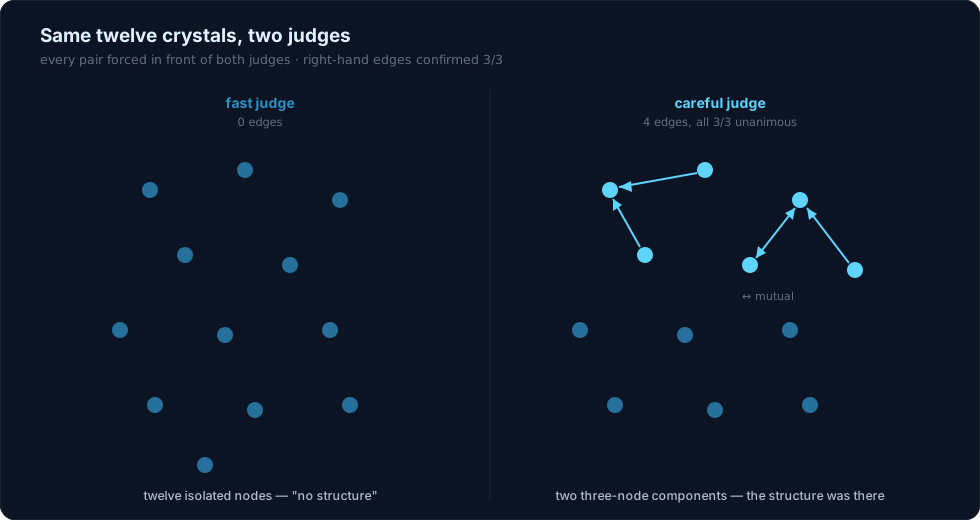
The same day supplied the verdict that mattered, from live data rather than a benchmark. Two fresh ignite runs had produced twelve new crystals, and their internal edge structure was measured with both judges — every pair, forced, nothing left to sampling.
The fast judge found zero edges in either run. The careful judge found four — every one of them confirmed by a three-repetition majority vote: a component of three crystals in each run, real inferential structure, unanimous on re-ask. Set beside the planted-positive misses, the day’s ledger reads: fast judge 0/4 field edges, careful judge 4/4.
That number resolved two open questions at once. An efficiency experiment earlier that day had appeared to show that a cheaper model configuration produced crystals with no structure — alarming, if true. It was the screen’s blindness, not the configuration’s sterility: the structure was there, the fast judge could not see it. And a chain-form experiment carried a pre-registered kill branch — if fewer than two chain edges form, the chain explanation is wrong — that would have fired falsely had its edges been counted by the fast judge alone.
There is no way to say this gently: structure is not a property of a corpus. It is a property of a corpus–judge pair. A falsification machine whose judge misses inferences will report an absence of structure that is not an absence — the most expensive kind of wrong, because it reads as a clean negative result.
A division of labour, not a winner
The decision that closed the week was deliberately not “switch to the better judge”. The fast judge earned its place with the benchmark’s cleanest line: zero false entailments in the false-positive test, at seventeen times the throughput — exactly what you want from a pre-screen that grinds thousands of candidate pairs and must, above all, not invent edges. The careful judge became the edge-measurer: any number that feeds a decision — component sizes, chain-edge counts, bridge checks, kill branches — is measured in the slow topology, at a cost of about twenty-five minutes per run, before anyone leans on it.
The general form of the rule travels beyond this system. When an LLM is your measuring device, sensitivity and specificity are separate axes, they trade off differently in different models, and no single judge is “the” instrument. You either measure the profile of the one you have and staff it accordingly — or you inherit its blind spots as facts about the world. The calibration behind these thresholds — and the judges’ measured throughput and power on this bench — belongs to the whitepaper.
What survives this section
Four rules, all paid for:
- Tag every reading with the judge that produced it. Untagged readings from mixed judges are not a dataset; they are an accident report waiting to be written.
- Lock decision rules before the data arrives. The locked threshold is the only reason an intuitive-but-wrong judge swap didn’t happen here.
- Latency is also data. The
17×anomaly was the entire discovery; a run that finishes suspiciously fast has usually answered a different question than the one you asked. - A negative structural result is only as strong as the judge’s sensitivity. Before reporting “no structure”, ask the sensitive judge — the fast one’s silence proves nothing.
The machine still refutes its own ideas with executable code. This week it refuted an idea about itself — and the refutation was cheap, pre-registered, and wrong in the most instructive possible direction.
Sources & further reading
- S.R. Bowman et al., A large annotated corpus for learning natural language inference (EMNLP, 2015) — the NLI task this judge performs.
- L. Zheng et al., Judging LLM-as-a-Judge with MT-Bench and Chatbot Arena (NeurIPS, 2023) — LLM judges and their biases as a research topic.
- D.M. Green & J.A. Swets, Signal Detection Theory and Psychophysics (1966) — sensitivity and specificity as the two axes of any detector.
- Marquis de Condorcet, Essai sur l’application de l’analyse à la probabilité des décisions (1785) — why a majority of imperfect voters beats one.
- J. Cohen, A coefficient of agreement for nominal scales (1960) — chance-corrected inter-rater agreement.
- B.A. Nosek et al., The preregistration revolution (PNAS, 2018) — locking decision rules before the data arrives.
— SF3D